Start · why bother
"Simple" is a compliment if you are learning the language
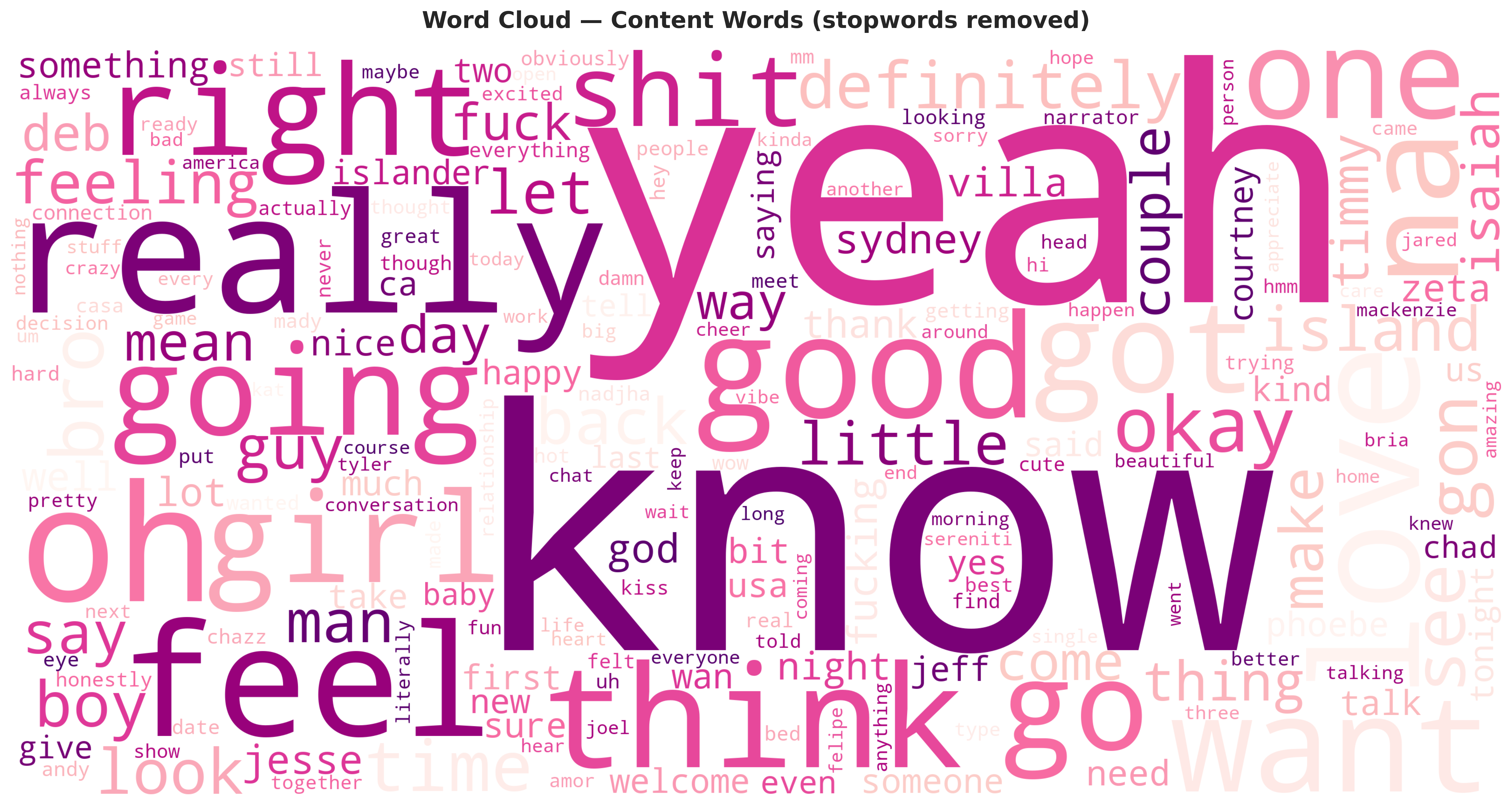
The obvious framing is mockery, and it is the least interesting one. The genuinely useful question is the one a language learner asks: how much English do I need before I can follow this? Native-speaker television is the standard advice for intermediate learners and most of it is far too hard.
A corpus answers that directly. Build the vocabulary coverage curve and the answer comes out as a number of words rather than an opinion.
↓ the useful number
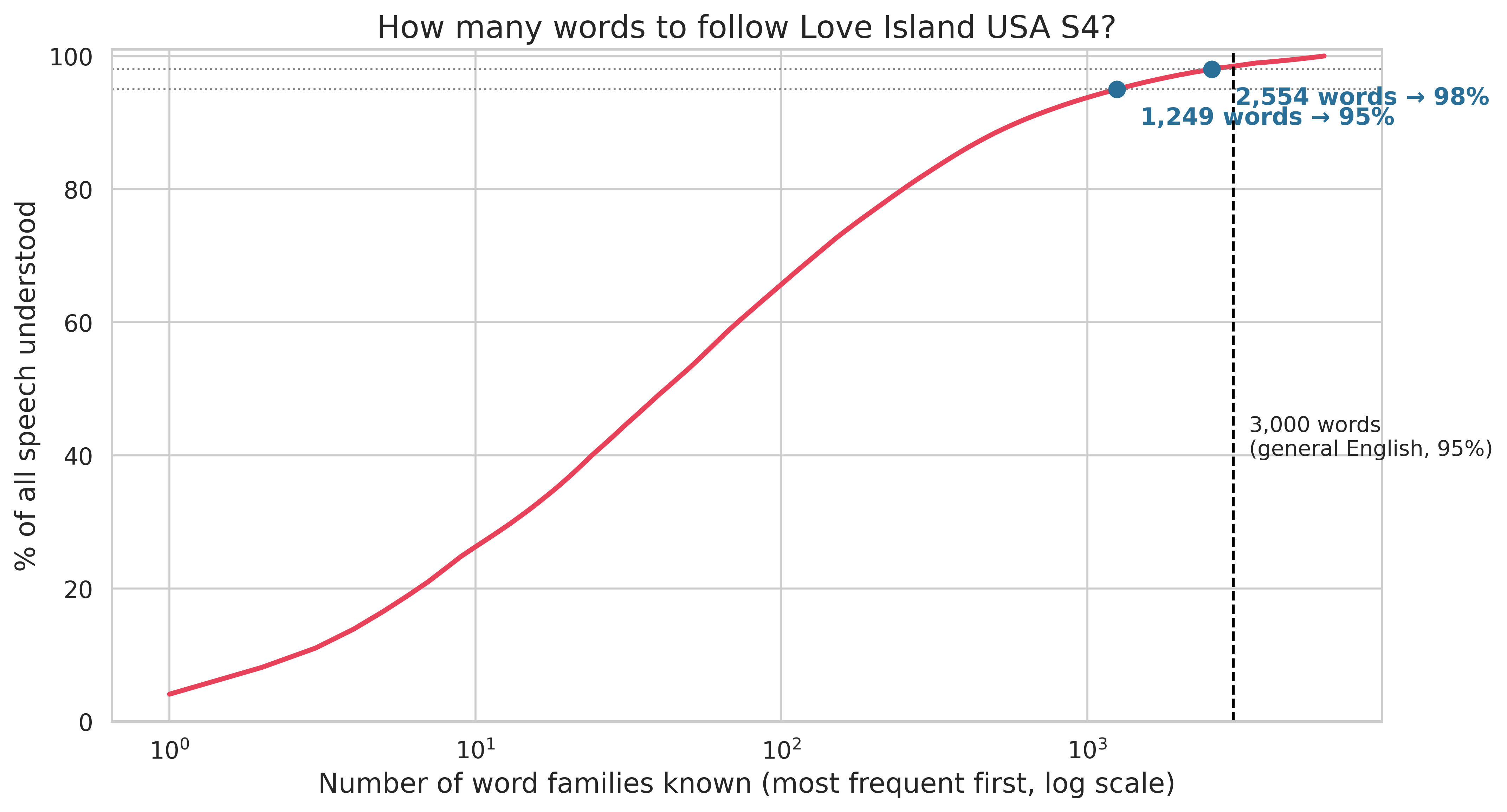
1,250 words gets you 95% of it
word families for 95% coverage. About 2,550 gets you to 98%.
Standard estimates put everyday English at roughly 3,000 word families for the same 95% threshold. This show needs well under half of that. For someone at an intermediate level, that difference is the difference between following along and constantly reaching for a dictionary.
↓ the distribution
Textbook Zipf, unusually steep in effect
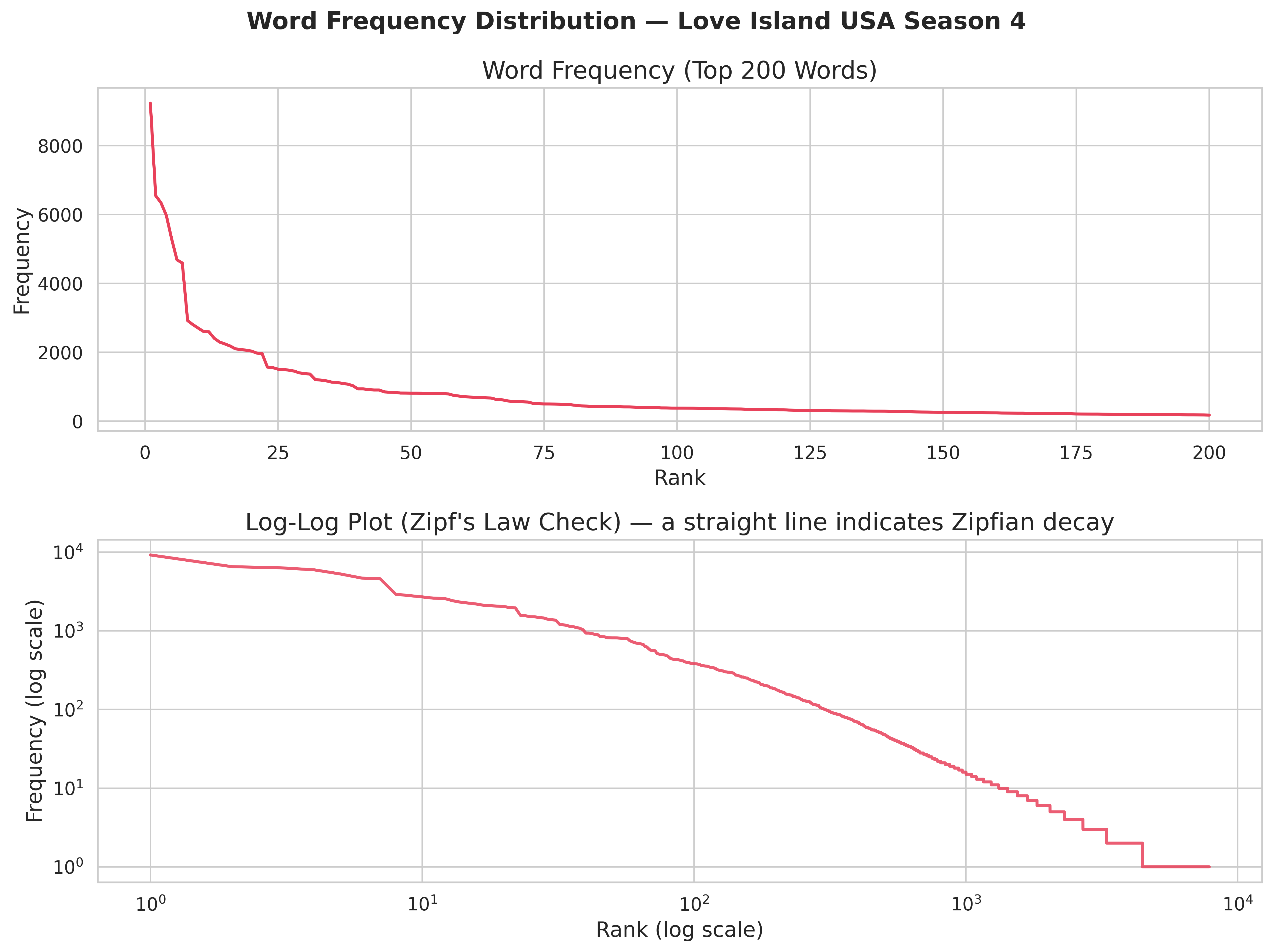
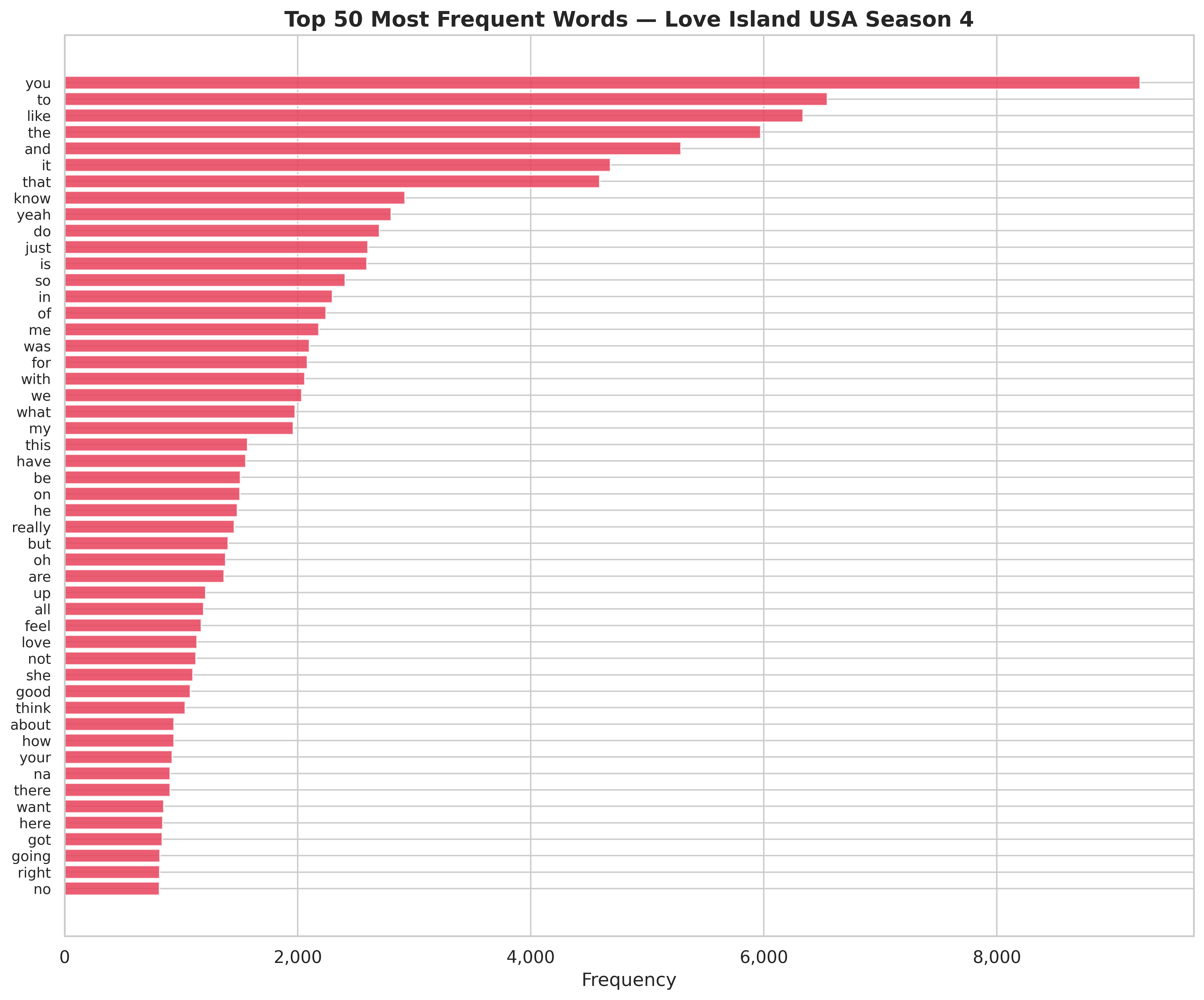
Word frequency follows Zipf's law almost exactly, at R² = 0.98. That in itself is unremarkable — nearly all natural language does. What is notable is the consequence here: the top 100 words carry 61% of all speech, so the long tail is doing very little work.
↓ texture
Flat, positive, and full of filler
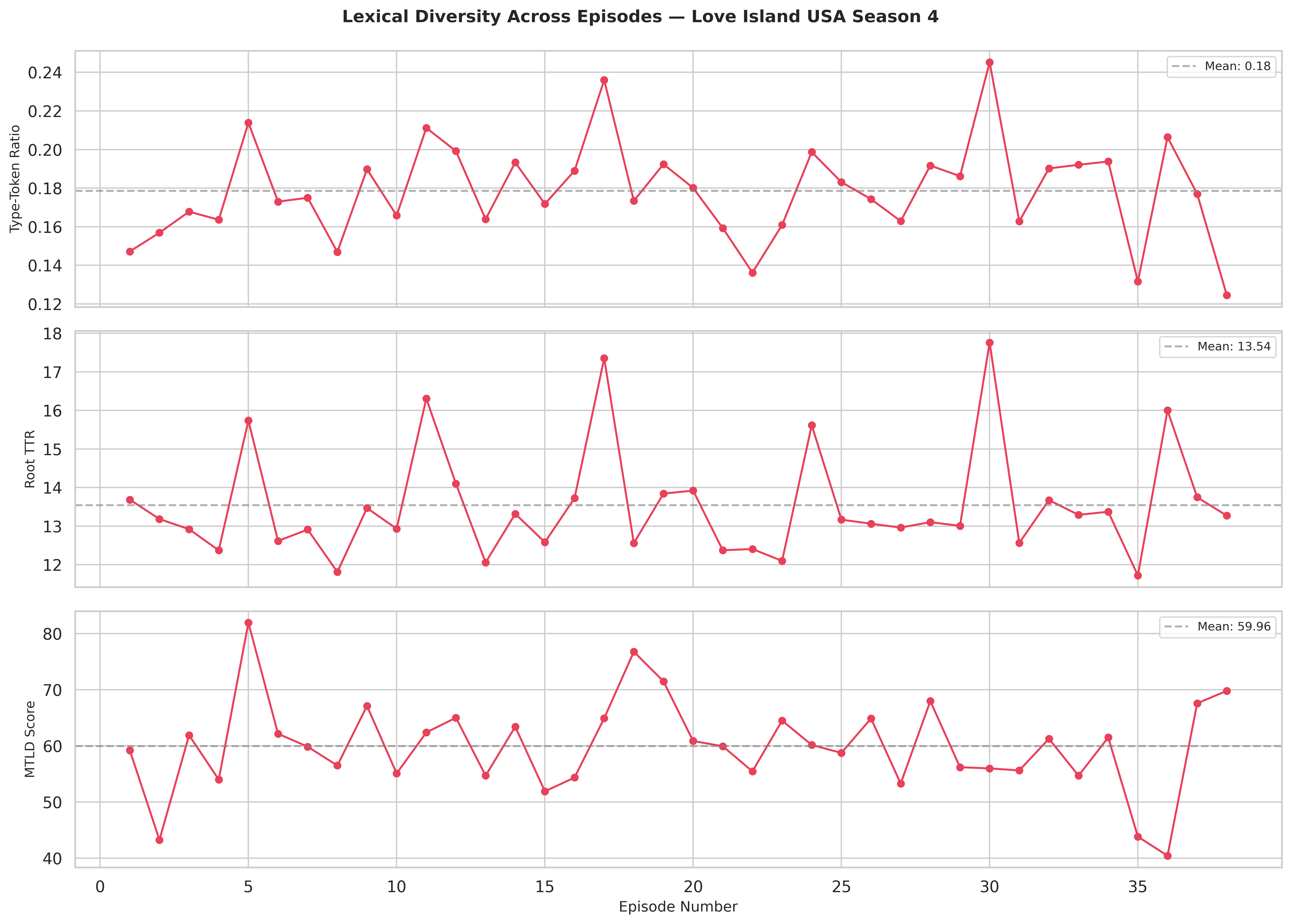
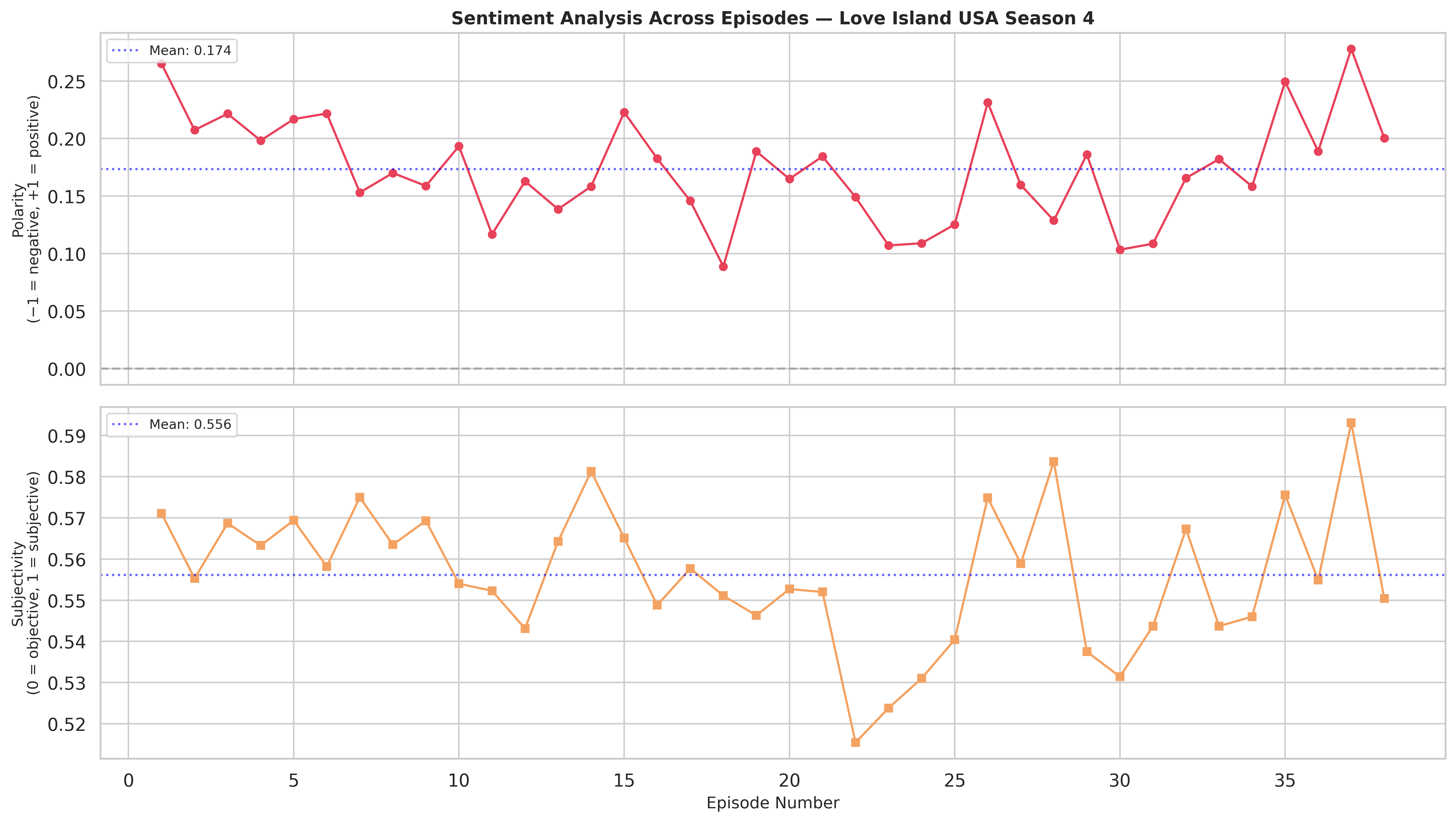
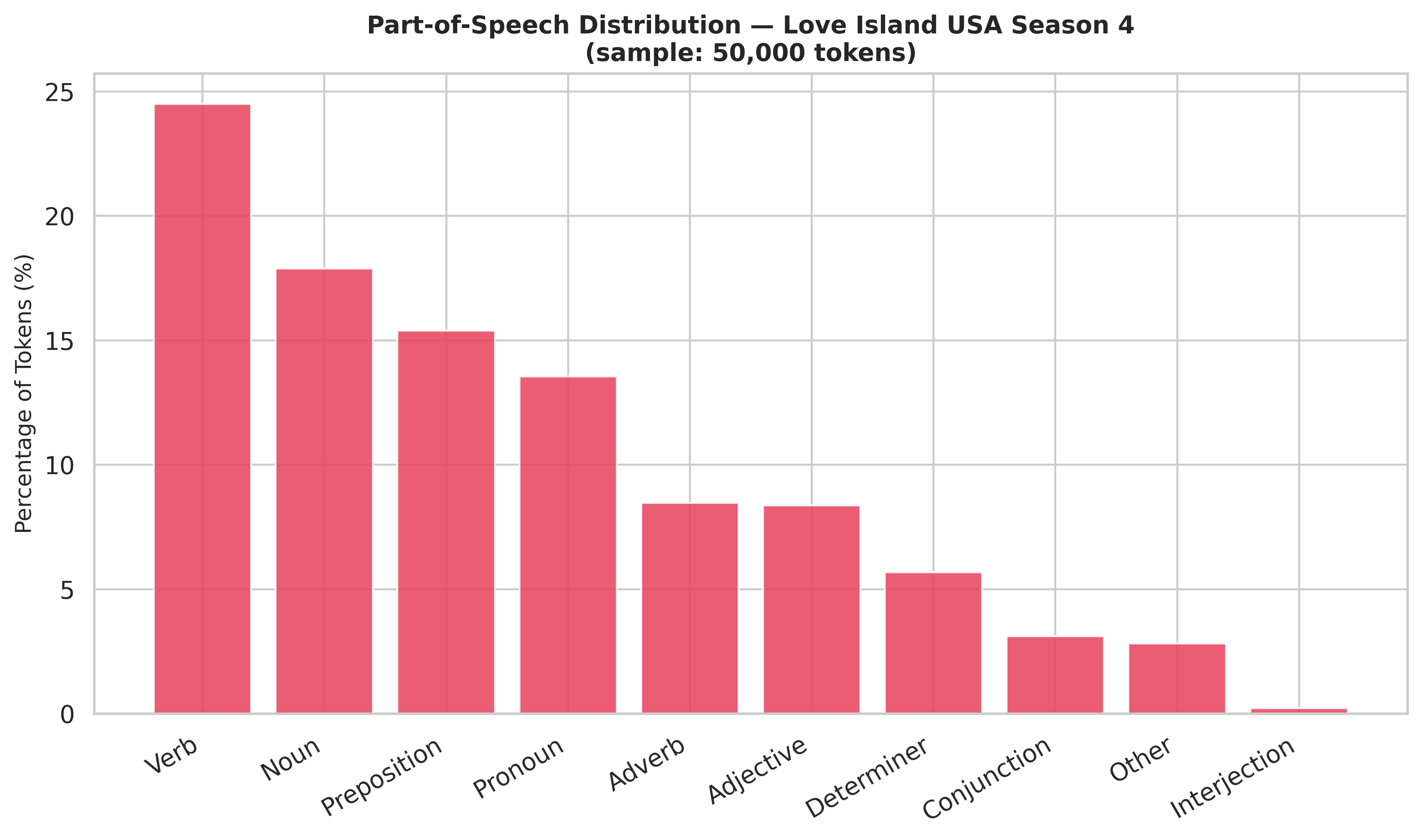
Lexical diversity sits at a mean MTLD of 59.96 with no trend across the season — episode 1 and the finale are linguistically indistinguishable. Sentiment is uniformly positive and highly subjective, and adjectives make up only 8.4% of speech, which is low for such emotionally saturated content.
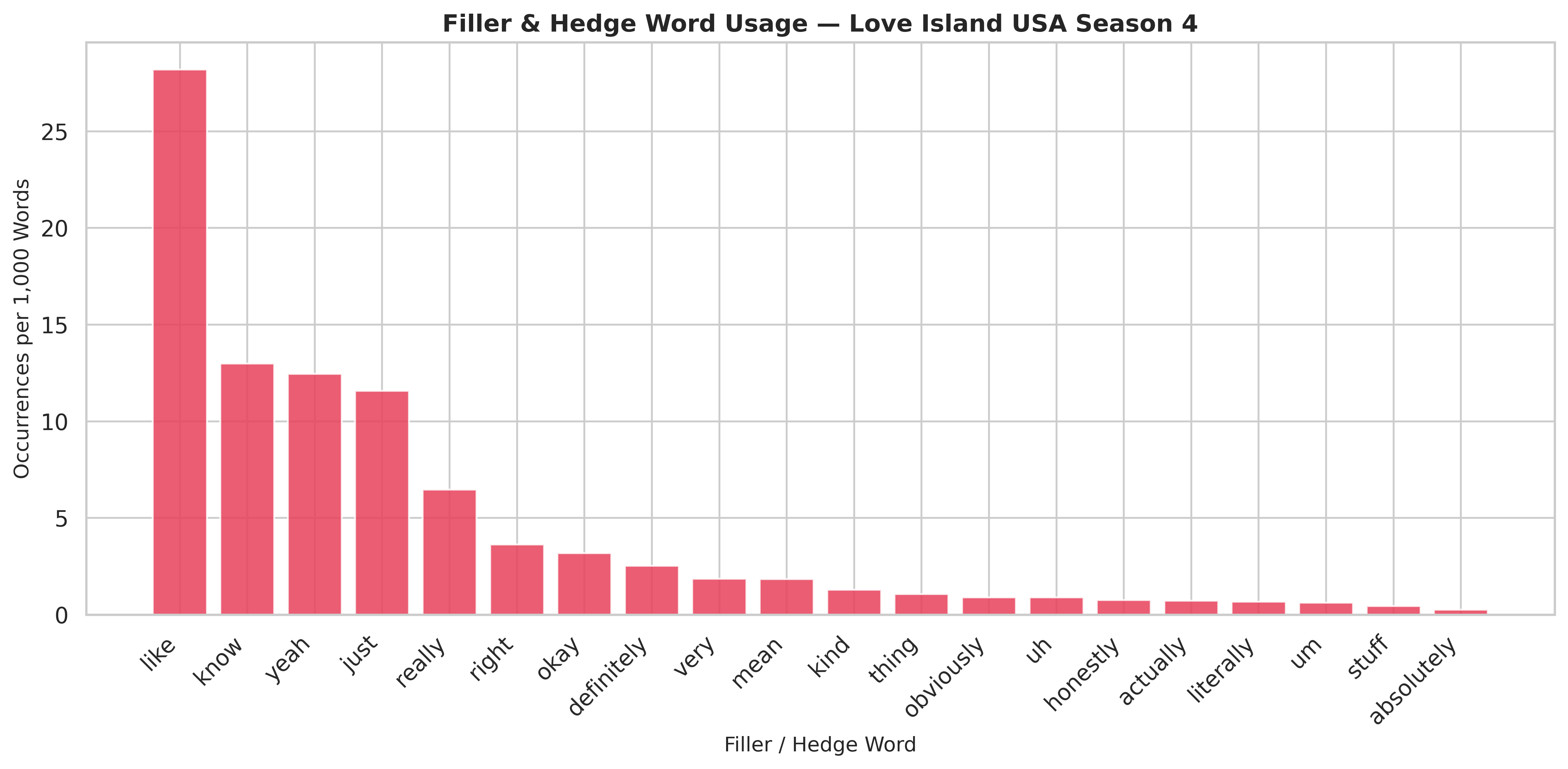
Filler words are their own chart, and they are not incidental. This is unscripted speech, which is exactly why it is easy: unscripted speakers reuse a small stock of words and lean on filler to buy time.
↓ what this cannot tell you
One season, and transcripts are not speech
This is a single season of a single show, so nothing here generalises to "reality TV" as a genre without more seasons to check against.
More importantly, transcripts flatten things that matter. Overlapping speech, prosody, and the pace of delivery are all invisible to a word-frequency analysis, and all three affect how hard something actually is to follow. A show can be lexically easy and still hard to parse at speed. The coverage number is a floor on difficulty, not the whole of it.
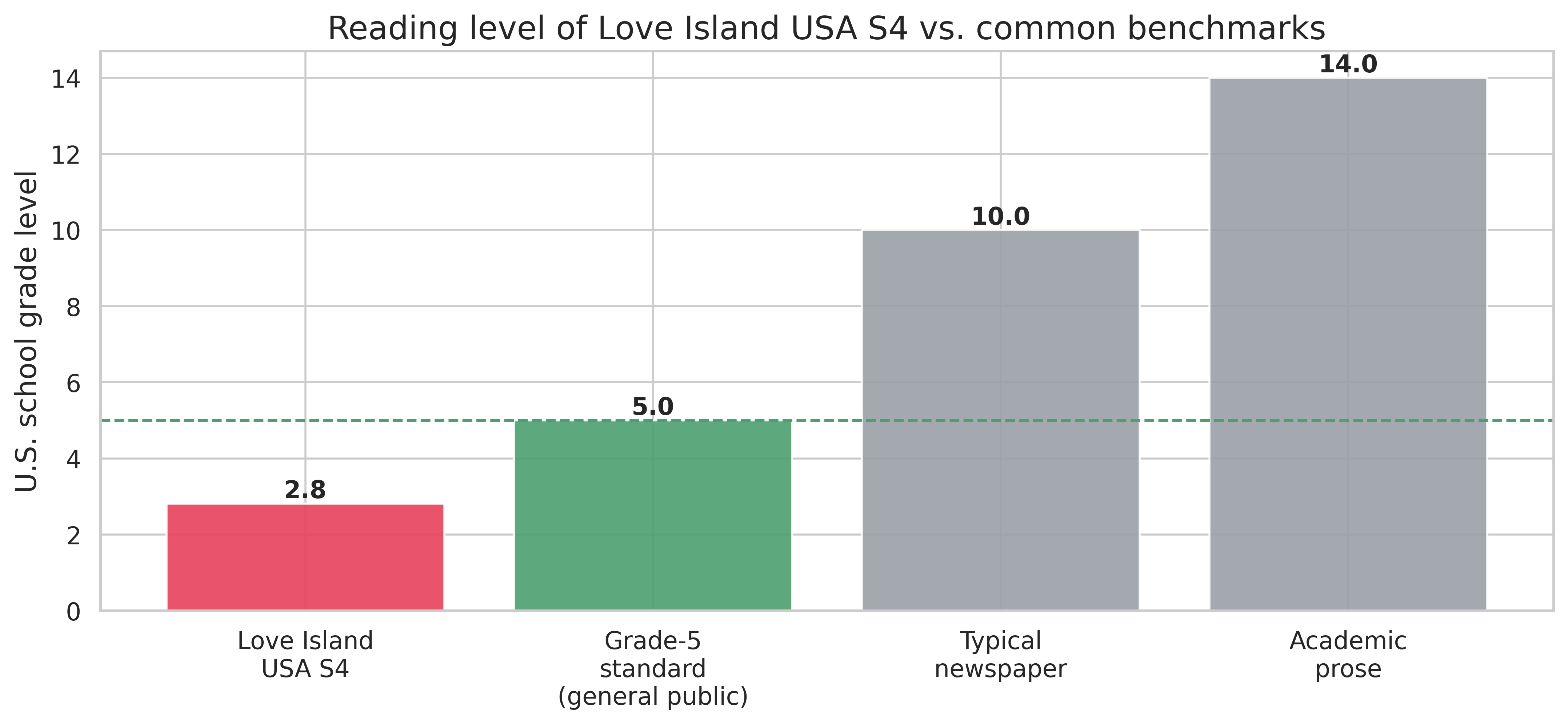
Reading-level measures were built for written prose and applied here to conversational speech. They are reported because they are comparable across studies, not because a grade level is a natural unit for dialogue.
Finish · how it was built
Where the numbers come from
The repository ships the cleaned corpus, one .txt per episode
plus a combined CSV, so the analysis is checkable rather than merely
described. The paper is written in Markdown, converted to LaTeX by a script
in the repo, and compiled to PDF.
- Corpus
- Every episode of Love Island USA season 4, scraped and cleaned, one row per episode
- Coverage
- Word-family coverage curve against a standard frequency list
- Diversity
- MTLD, which is stable across differing text lengths in a way type-token ratio is not
- Built with
- Python, pandas, nltk, textblob, textstat, wordcloud, matplotlib
- Figures
- Twelve, at 400 DPI, regenerated by two scripts writing to
LI_OUTPUT_DIR - Related
- The same lens on pop lyrics in Are song lyrics getting simpler?, and turned into a tool anyone can point at a book in the EPUB reading-level analyzer