1 · The schema has no room
The Receipt and LineItem models simply have no
fields for cardholder name, card number, address or loyalty id. The
vision model is never asked for them.
The risk with receipts is not bad OCR. It is a confident wrong total.
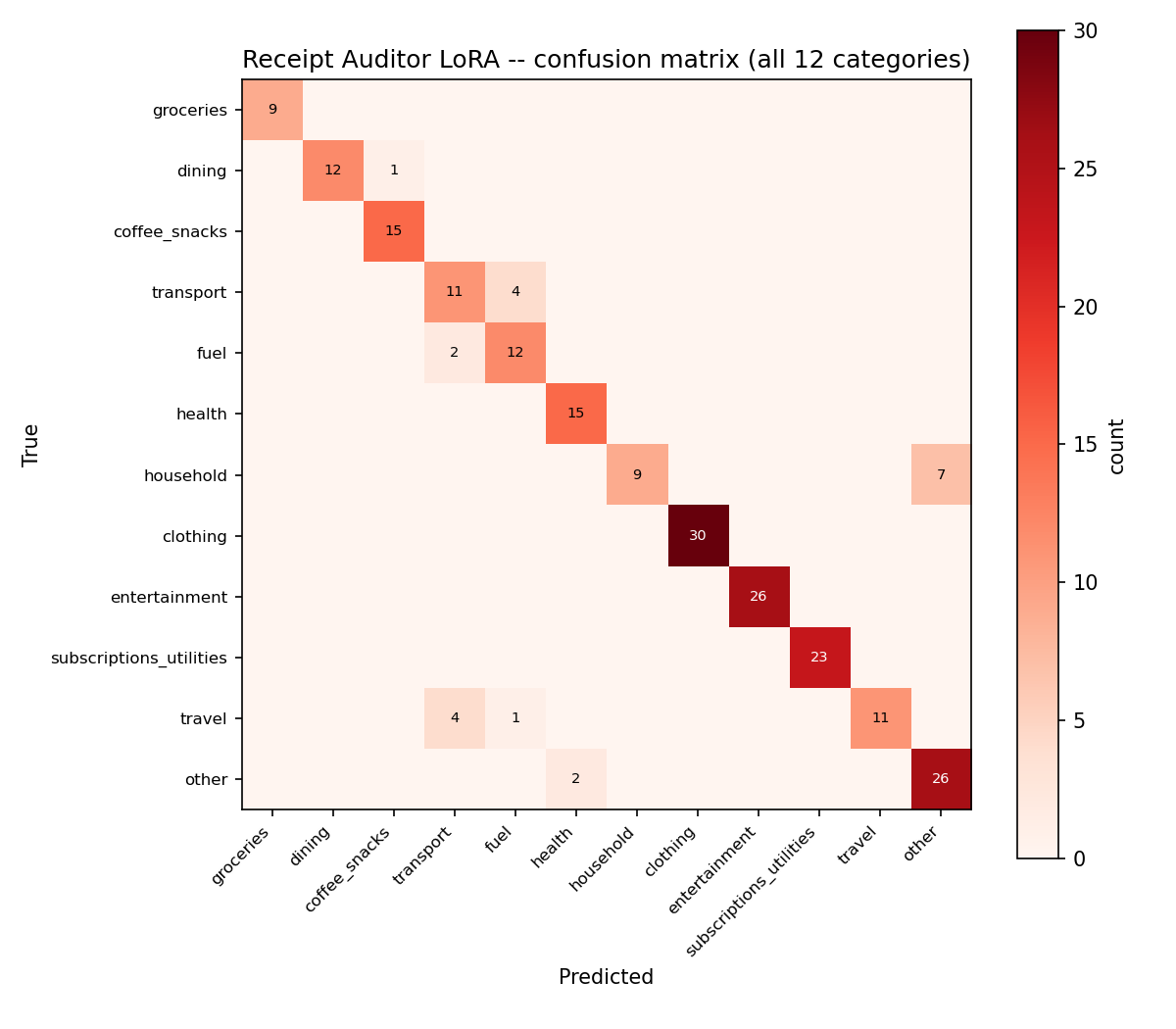
Photograph a stack of receipts and get reconciled, categorized spending you can query out loud. Totals are checked in plain code against the printed total. Spending answers are computed by pandas and only phrased by the model, with a guard that rejects the phrasing if a number changes. And the categorizer is a 1.5B model fine-tuned on this laptop that beats Claude's zero-shot accuracy by 34.5 points.

Top-1 category accuracy from the fine-tuned model, against Claude's zero-shot 56.0% on the identical blind prompt.
macro-F1, against 0.506. It holds up across all twelve categories, not just the common ones.
of PII defence, starting with a schema that has nowhere to put a card number in the first place.
numbers originating from the model in a spend answer. The guard makes a hallucinated figure structurally impossible.
↓ the headline result
against Claude zero-shot at 56.0%, on the same twelve-category blind prompt.
All three systems saw the identical prompt with no category list supplied, matching the training format exactly. The fine-tuned model was not handed a hint the others lacked — this is a fair comparison of what each brings on its own.
| System | Top-1 acc | Macro-F1 | Latency | Cost/1k |
|---|---|---|---|---|
| Base Qwen2.5-1.5B (no fine-tune) | 27.7% | 0.333 | 5.0s | $0 |
| + LoRA (this project) | 90.5% | 0.893 | 4.5s | $0 |
| Claude (teacher, zero-shot) | 56.0% | 0.506 | 17.7s | Max sub |
It is also four times faster and costs nothing per call. The
training set is 4,799 synthetic line items written in realistic point-of-sale
styles — SBUX #4821, WM SUPERCENTER #2847,
TST* JOE'S PIZZA — and split by merchant, so no
merchant appears on both sides of the split.
↓ the design idea
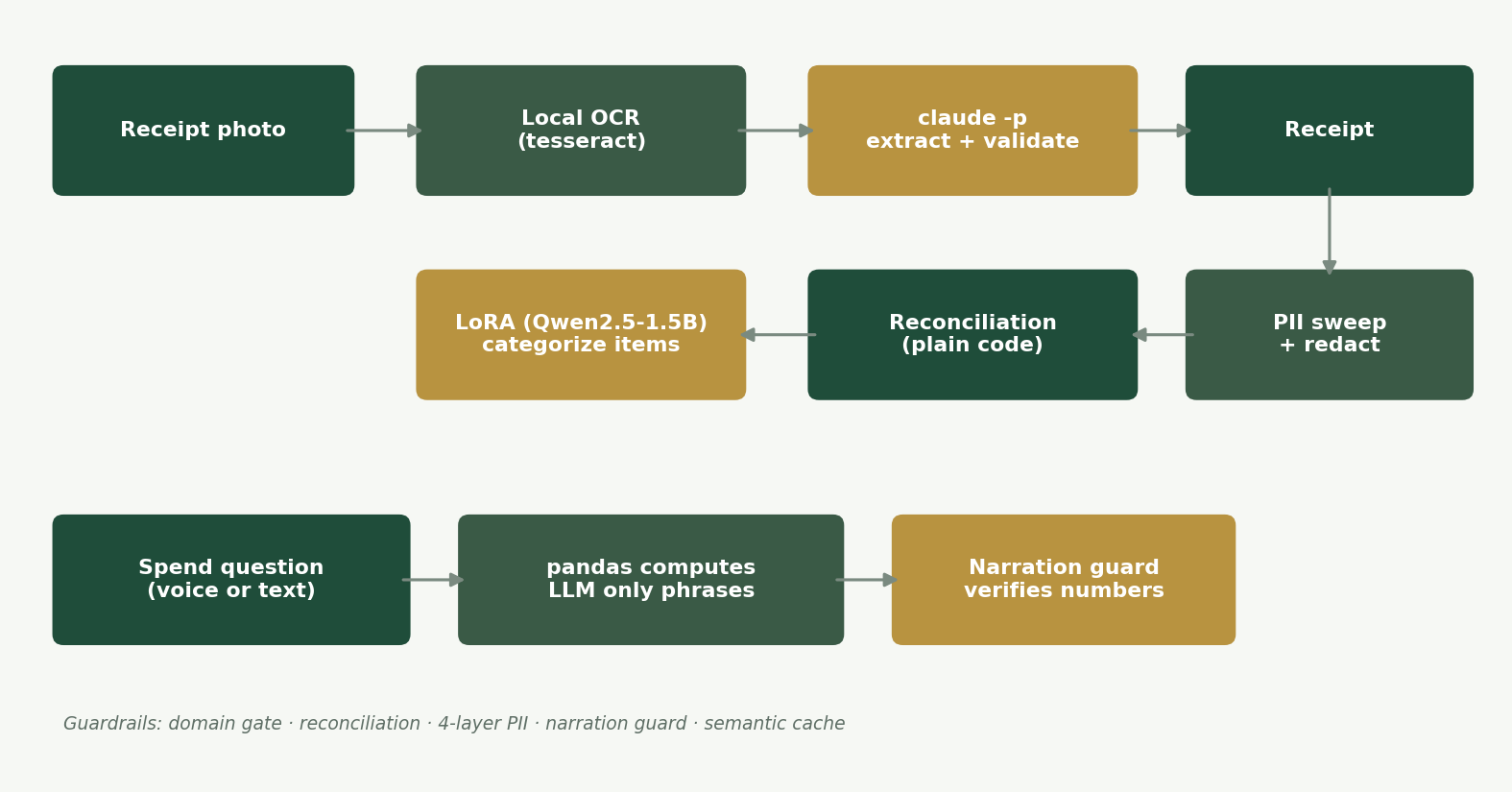
Ask "how much did I spend on dining in March" and the arithmetic is done by
analysis.answer_query in pandas. The LLM receives the computed
figures and is asked only to turn them into a sentence. Then
reconcile.assert_numbers_present checks that every number it was
given still appears in what it wrote — and if one was dropped or altered, the
caller falls back to a template sentence.
This is the difference between asking a model not to hallucinate and building a path where it cannot. There is no code route by which a number the model invented reaches the screen.
A hallucinated number is structurally impossible here, because the number never originated from the model.
From the repository's own README↓ reconciliation
For each receipt, computed = Σ(line items) + tax is compared
against the printed total within a small tolerance. When they disagree the
receipt is rendered flagged for one-tap human review rather
than silently adjusted to agree.
Silently correcting a mismatch is the tempting behaviour and the wrong one: it destroys exactly the signal that tells you the OCR misread a line.
↓ privacy
The Receipt and LineItem models simply have no
fields for cardholder name, card number, address or loyalty id. The
vision model is never asked for them.
Only the validated Receipt object survives extraction. The
full text, with whatever was on it, does not persist.
privacy.sweep_receipt redacts anything PII-shaped that got
into a merchant or item string, and reports how many redactions it made.
On a hosted Space everything stays in memory.
privacy.is_space_environment() is the single source of truth
both paths check before persisting anything.
↓ the gap, reported not hidden
There is currently no real-receipt held-out column in the benchmark. The specification calls for 10–20 real receipts, photographed and hand-labelled, as the honest synthetic-versus-real tiebreaker, and that has not been supplied yet.
So 90.5% is a real number on a real held-out split with no merchant leakage, and it is a number about synthetic line items. A model trained and tested on the same generator can share that generator's blind spots. Until the real slice runs, that caveat travels with the headline.
Finish · what it is built on
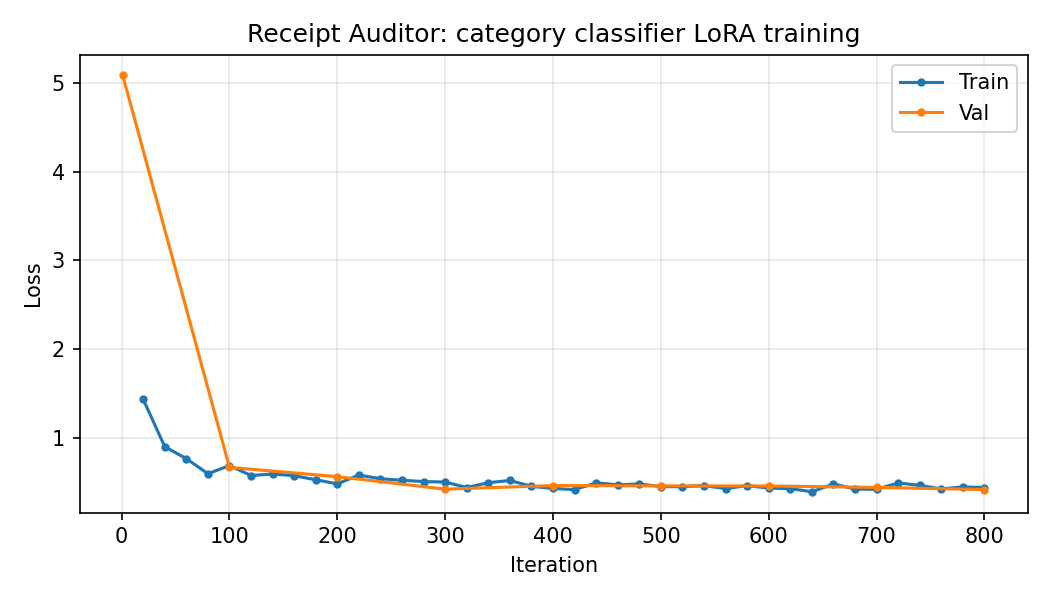
mlx_lm.generate"other" category if the adapter is absent — inspectable, not a black boxtesseract locally, then claude -p for extraction from the OCR'd texttraining/bench_categorizer.py