
# Receipt Auditor: a finance app where the model is never allowed to do arithmetic
*Photograph a stack of receipts, get reconciled spending data — and a
locally fine-tuned classifier that categorizes each line item better than
Claude does cold.*
## The idea
Ask a chatbot "how much did I spend on dining last month" from a pile of
receipt photos, and you're trusting it to read every number correctly *and*
report the sum honestly — two separate ways for it to be confidently wrong.
Receipt Auditor is built around a different rule: **the model narrates, the
code computes.** Totals are reconciled against the printed total in plain
Python. Spend queries are answered by pandas. The model only ever phrases a
number it was handed, and a guard checks that the number survived phrasing
unchanged.
It's also a testbed for five specific engineering skills, same as the rest
of this project family: fine-tuning, guardrails, multimodal input, context
engineering, and token optimization — each with a real number attached, not
a bullet point.
## No Gemini key, no problem
Like its sibling projects, this one was originally spec'd around Gemini's
vision API for receipt extraction. Two API keys tested in Session 1 both
authenticated but had zero free-tier quota provisioned — a
project-configuration issue on Google's side, not a rate limit that clears.
Rather than block on a third key, extraction was rebuilt to be **fully
local**: `tesseract` OCRs the receipt photo, then `claude -p` (my Claude
subscription, no per-token API cost) does the domain check and structured
field extraction from the OCR'd text in one call — refusing non-receipt
photos, flagging low-confidence reads. Zero external dependency, same
guarantees.
## Reconciliation and the narration guard: arithmetic the model never touches
Every receipt's computed total (`Σ line items + tax`) is checked against the
printed total in plain code, with a small tolerance for rounding noise. A
mismatch renders flagged for a one-tap human correction — the model never
gets to quietly "fix" a total that doesn't add up.
The same discipline extends to spend analysis. When you ask "how much did I
spend on dining," pandas computes the real number from the parsed receipts;
the LLM's only job is to phrase it as a sentence. After phrasing,
`assert_numbers_present` checks that every number the model was given still
appears in its output — verbatim, allowing only reasonable rounding (`$42`
vs `$42.00`, not a changed value). If a number gets dropped or altered in
phrasing, the caller falls back to a plain template sentence instead of
shipping the LLM's version. A hallucinated spend total is structurally
impossible here, because the number the model speaks was never the model's
to invent.
## Privacy: four layers, not a policy statement
1. **Schema-as-guardrail.** `Receipt` and `LineItem` simply have no fields
for cardholder name, card number, address, or loyalty id — the vision
model is never even asked to extract them. The cheapest PII control is a
schema that can't hold PII.
2. **Raw OCR text is discarded.** Only the validated, schema-checked
`Receipt` object survives extraction; the OCR'd text itself is never
cached, logged, or persisted anywhere.
3. **Belt-and-braces sweep.** `privacy.sweep_receipt` runs a regex redaction
pass over every merchant/item string before it touches cache or
persistence — long digit runs (card fragments) get last-4-masked, emails
and phone numbers get replaced with `[redacted]`. The redaction count is
surfaced, not hidden.
4. **Persistence policy.** `privacy.is_space_environment()` is the single
source of truth both the local and hosted paths check: on a Space,
receipts live in memory for the session and nothing touches disk; locally
a git-ignored ledger opt-in is allowed.
## The fine-tune: a classifier that beat the teacher by 34 points
The task: given a merchant string and a line-item description, predict the
spend category — 12 classes, from `groceries` to `subscriptions_utilities`.
**4,799 synthetic line items** generated via `claude -p` across deliberately
varied POS abbreviation styles real receipts actually use ("SBUX #4821", "WM
SUPERCENTER #2847", "TST* JOE'S PIZZA", full readable names, generic local
merchants), split **by merchant** (not by row) so no merchant's items
straddle train and test — 2,537 distinct merchants in train, 158 in test,
zero overlap.
A Qwen2.5-1.5B model was LoRA fine-tuned locally (MLX, Apple Silicon, same
hyperparameters as this project family's other classifiers: batch 4, 12
layers, 800 iterations, lr 1.5e-4) — training loss fell from an initial
val loss of 5.085 to 0.419 over 800 iterations
(`eval/loss_curve.png`). Benchmarked three ways on a held-out 220-row test
set, **all three systems given the identical blind prompt** (merchant +
item, no category list in-context — matching what the LoRA model actually
trained on, the same methodology this project family used for Cellar
Scanner's variety classifier):
| System | N | Top-1 acc | Macro-F1 | Latency | Cost/1k calls |
|---|---|---|---|---|---|
| Base Qwen2.5-1.5B | 220 | 27.7% | 0.333 | 5.0s | $0 |
| **+ LoRA (this project)** | 220 | **90.5%** | **0.893** | 4.5s | $0 |
| Claude (teacher, zero-shot) | 150 | 56.0% | 0.506 | 17.7s | Max subscription |
The headline: **the fine-tuned local model's Top-1 accuracy (90.5%) beats
Claude's zero-shot Top-1 (56.0%) by 34.5 points** — and both numbers come
from the exact same blind prompt, so this isn't LoRA getting a vocabulary
hint Claude didn't see. Fine-tuning bought a **3.3x lift** over the
untrained base model. This is a narrower, more memorizable task than Cellar
Scanner's 40-variety wine guess (12 classes on a synthetic corpus with
consistent internal structure), which is exactly why the gap over a
zero-shot frontier model is so much larger here — Claude has to guess a
category *name* cold with no enumerated options, while the LoRA model
learned the label space directly from its training signal.
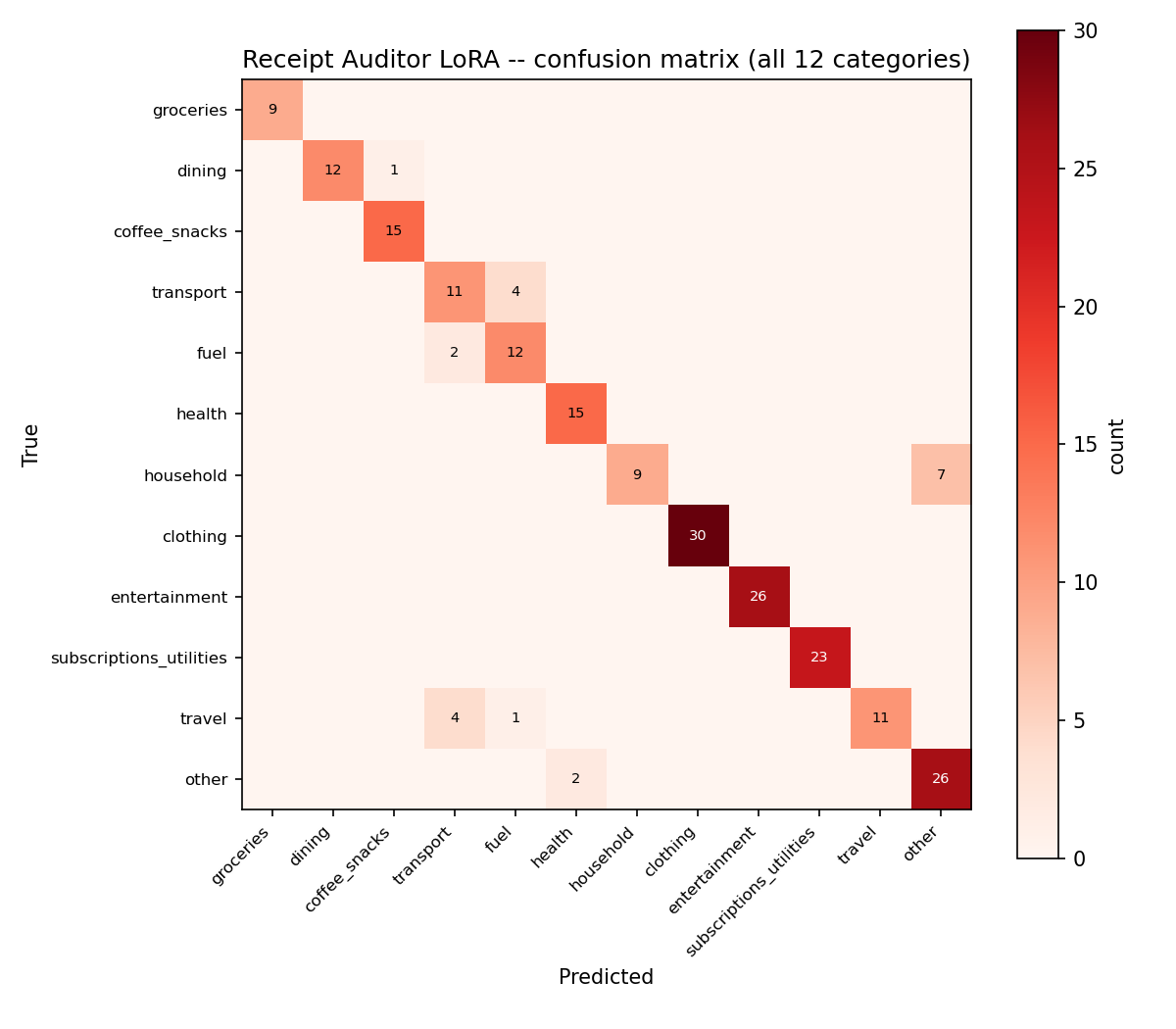
The confusion matrix (`eval/confusion_matrix.png`) shows where the LoRA
model still slips: `household` items called `other` (7 of its confusions —
genuinely ambiguous items like generic home-goods purchases), `travel`
confused with `transport` and `fuel` (a car-adjacent, geographically
overlapping trio even for a human categorizing a credit card statement), and
a few `transport`/`fuel` mix-ups in both directions.
**One gap reported, not hidden:** there is **no real-receipt held-out
column**. The spec (`RECEIPT_AUDITOR_SPEC.md` §5) calls for 10–20 of
Jeremy's actual receipts, vision-extracted and hand-labeled, as the honest
synthetic-vs-real tiebreaker — precisely because Claude both labeled the
synthetic training data *and* is the zero-shot reference column, so a
same-distribution benchmark alone can't fully rule out the synthetic corpus
being easier than real-world receipts. That set hasn't been supplied yet;
the 90.5%/56.0%/27.7% numbers above are synthetic-only, and the writeup says
so rather than presenting them as the final word.
## Context engineering and token optimization, measured not claimed
Voice and text spending questions are parsed into a structured `Query`
(metric, category, merchant, date range) via the same
`generate_validated` retry loop every project in this family shares, then
answered entirely by pandas — the LLM sees the question and the final
number, never the underlying dataframe. Repeat questions ("how much did I
spend on dining this month," asked twice) hit a semantic cache keyed on
question similarity, avoiding a repeat parse-and-phrase round trip.
## What building this taught me
- **Two real bugs, caught immediately by the test suite, not in
production.** The `Receipt` schema originally risked a `date` field
shadowing Python's `datetime.date` type — a classic naming collision that
breaks Pydantic model construction outright the moment both the field name
and the type import collide in the same scope. And the narration guard's
original number-extraction regex could match a bare trailing comma left
over from a comma-separated sentence (`"...$120.00, up from..."`) and crash
on `float("")` when trying to parse it as a number. Both were caught by
writing realistic test cases *before* trusting the code — a sentence with
multiple comma-separated numbers for the second one — and both are fixed;
19 tests pass across reconciliation, privacy, and analysis.
- **A benchmark timeout that turned out to be someone else's CPU load, not
a bug in this project.** The first live benchmark run hit repeated
90-second timeouts on `mlx_lm.generate` calls that normally take a few
seconds. Instead of assuming the model or the harness was broken, checking
system load first (`uptime`, `ps aux` sorted by CPU) showed two unrelated
VS Code helper processes consuming 97% and 65% CPU on this 10-core
machine — nothing to do with this benchmark. Raising the subprocess
timeout to 240 seconds (rather than "fixing" code that wasn't broken) let
the run complete cleanly.
- **A logging path that silently wrote nothing, caught before it mattered.**
`train.sh`'s `tee` command was supposed to write the full training log to
`training/adapters/train.log` for the loss-curve script to parse, but the
file came out at 0 bytes even though training itself completed
successfully — likely a quirk of piping through a Google-Drive-synced
directory. The same content had already landed in the outer run log from
a different redirect, so the loss curve was reconstructed from that
instead of being silently lost.
None of these would have surfaced from reading the code alone — every one
came from actually running the pipeline and treating an unexpected number,
timeout, or empty file as a bug report worth investigating, not noise to
retry past.
---
*Built by [Jeremy Lee](https://github.com/lyhjeremy). Code, benchmark, and
dataset card: [github.com/lyhjeremy/receipt-auditor](https://github.com/lyhjeremy/receipt-auditor).*